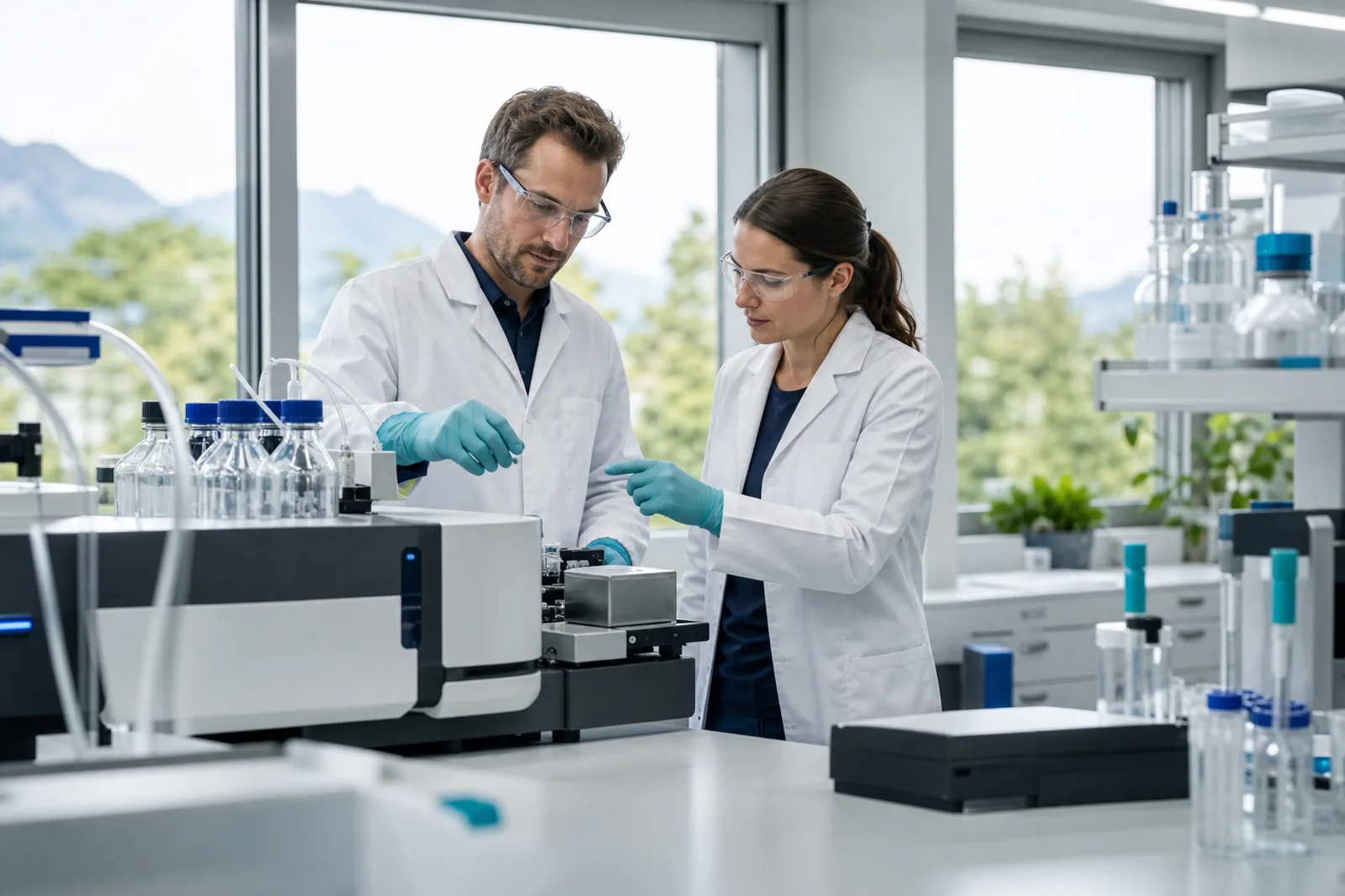
A flow cytometer costs between €150,000 and €400,000 to purchase new. The University of Graz has three. On any given Tuesday afternoon, statistically, at least one of them is sitting idle — powered down between experiments, waiting for the next project cycle to begin. Across Austria's research landscape, this scene repeats thousands of times each day, across centrifuges, mass spectrometers, confocal microscopes, PCR systems and liquid handling robots. The cost of this underutilisation is not abstract: it is the reason a biotech startup in Linz is paying €600/day at a core facility, waiting six weeks for a 48-hour experimental window, burning through its seed funding on access fees rather than on science.

Lab equipment sharing is the structural fix. It is not a workaround — it is the same shift that transformed office space (WeWork), computing (AWS) and transportation (car-sharing). This article explains what lab equipment sharing means specifically for Austrian life science organisations, what it costs, what it saves, and how LabWallio's model works.

40–60% of lab equipment is idle on any given day
€12k average annual savings per startup using equipment sharing
6 weeks typical waiting time for core facility slots in Austria

What Is Lab Equipment Sharing?

Lab equipment sharing is a model in which laboratories, universities, or companies make their underutilised instruments available to external researchers on a fee-per-use or time-slot basis. Instead of every organisation purchasing its own flow cytometer or mass spectrometer, multiple users share access to a single instrument. The equipment stays in place. Researchers travel to it, run their experiment, and leave. The owner earns revenue from capacity that would otherwise produce nothing. The renter gets access at a fraction of the purchase cost.

This is distinct from core facilities (which are institutionally managed, slow and expensive) and from equipment leasing (which transfers possession of the instrument). Sharing is access without ownership. The access is typically mediated by a digital platform that handles discovery, confidentiality agreements, scheduling, and payment. Research published in PLOS ONE and cited across the equipment management literature consistently shows that shared access models reduce total research costs by 30–50% compared to owned or traditionally rented alternatives. A PubMed search on laboratory resource sharing returns over 1,200 studies on this topic since 2010.

The Austrian Life Science Landscape

Austria punches above its weight in life sciences. The sector employs more than 26,000 people directly and generated over €4.5 billion in revenue in 2024, with Graz, Linz and Vienna forming the three primary innovation clusters.

Vienna hosts the highest density of biotech and pharma companies, anchored by LISAvienna, the life science cluster organisation that supports more than 350 member companies. The Vienna BioCenter alone houses over 1,900 scientists across 13 institutions. Graz (Steiermark) has built a strong medical technology and diagnostics corridor, with TU Graz and the Medical University of Graz driving applied research. Linz (Oberösterreich) is the emerging hub for industrial biotech and green chemistry, supported by JKU Linz and a growing deep-tech startup scene backed by INiTS Universitätszentrum and WKO's Life Sciences sector support programmes.

Despite this density, infrastructure access remains a persistent bottleneck. Early-stage startups — the majority registered through Austrian Startups network nodes in all three cities — consistently rank equipment access as a top-three barrier to growth, alongside talent and regulatory complexity.

Why 40–60% of Lab Equipment Sits Idle

The underutilisation of scientific equipment is not caused by laziness or poor planning. It is a structural consequence of how research is funded and executed.

Research projects are phase-based: intensive data collection for 2–4 weeks, followed by analysis, writing, and grant reporting periods where the instruments are not needed. A lab that wins a three-year FWF project grant buys the equipment it needs for that project — but the instrument sits idle during every phase that does not require it. Austrian research institutions are also budget-constrained in terms of how they can monetise their assets: most academic labs cannot easily invoice external parties without institutional overhead, compliance approvals, and administrative infrastructure that simply does not exist for one-off bookings.

A 2021 systematic analysis of research infrastructure utilisation across European universities (referenced in the FFG infrastructure programmes) estimated average instrument utilisation at 38% across all device classes, with high-capital equipment like mass spectrometers and cell sorters averaging even lower at 22–31%. FFG Austria's COIN and TAKE OFF programmes fund equipment purchases with exactly this problem in mind — but do not yet fund sharing infrastructure.

The Real Cost of Lab Equipment in Austria

These are real market prices, not estimates. They reflect what Austrian life science organisations pay in 2025–2026.

Instrument Purchase Price Core Facility Rate LabWallio Sharing Rate
Flow Cytometer (4-laser) €150,000 – €400,000 €400 – €800 / day €180 – €320 / day Save ~55%
LC-MS / Mass Spectrometer €200,000 – €800,000 €500 – €1,200 / day €220 – €480 / day Save ~60%
qPCR Cycler (96-well) €15,000 – €45,000 €80 – €200 / day €35 – €80 / day Save ~55%
Confocal Microscope €80,000 – €250,000 €200 – €500 / day €90 – €200 / day Save ~55%
Ultracentrifuge €40,000 – €120,000 €100 – €250 / day €45 – €100 / day Save ~50%
Automated Cell Counter €8,000 – €25,000 €50 – €120 / day €20 – €50 / day Save ~55%

A typical early-stage biotech startup in Austria runs 20–30 instrument-days of experiments per year across 3–5 instrument types. At core facility rates, this costs €8,000 – €18,000 annually. The same experimental programme via lab equipment sharing costs €3,500 – €8,000. That is where the €12,000 annual saving figure comes from — and it compounds as the company scales.

Want to see what your team would save? LabWallio founding members get priority access, locked-in rates and direct input on the equipment categories we prioritise. Join the waitlist — Vienna launch Q3 2026.

How Lab Equipment Sharing Works: The LabWallio Model

LabWallio operates on a no-transport principle. The instrument never leaves the host lab. This is not a logistical convenience — it is fundamental to making sharing viable. Moving a mass spectrometer requires specialist packaging, calibration on arrival, and creates liability exposure that most labs will not accept. The sharing model only works at scale if instruments stay where they are and people come to them.

The process runs in three steps:

  1. List or Search. Equipment owners list their instruments with technical specifications, available time slots, access requirements, and pricing. Searchers enter what they need, when, and where. The platform matches on instrument type, geography, biosafety class and availability.
  2. Connect Securely. Before either party sees contact details or location information, LabWallio generates a digital non-disclosure agreement. Both parties sign it digitally. The NDA covers experimental data, proprietary methods, and the identity of both organisations for the duration of the access period. Only after NDA execution does the booking become confirmed and contact details exchange.
  3. Visit and Run. The researcher travels to the host lab at the booked time. The host provides instrument access and, optionally, basic operational support. The researcher runs their experiment with their own samples and reagents. Payment is processed automatically at session completion. No invoice chasing, no overhead allocation debates.

LabWallio takes a platform fee on each completed booking. Equipment owners keep the majority of the session fee. There is no subscription for researchers — you pay only when you book. Learn more about the full process on the How It Works page, or see current pricing tiers for equipment owners and research teams.

Environmental Impact: The CO₂ Case for Sharing

Manufacturing a single high-end analytical instrument — a mass spectrometer, an electron microscope, a robotic liquid handler — generates an estimated 8–25 tonnes of CO₂-equivalent in production, materials and logistics, before the device switches on for the first time. When that instrument runs at 25% capacity for its 10-year service life, the carbon cost per experiment is dramatically higher than if it ran at 70%.

LabWallio's internal lifecycle model estimates that each equipment-sharing session avoids approximately 12.4 kg CO₂e compared to the counterfactual where the researcher's organisation would have purchased a dedicated instrument. Across 1,000 sessions, that is 12.4 tonnes — equivalent to five return flights Vienna–New York. This aligns directly with Austria's climate strategy and FFG's green research infrastructure priorities. The circular economy argument here is not marketing — it is mathematically sound: higher utilisation of existing capital goods is always more resource-efficient than manufacturing new ones.

Who Benefits Most from Lab Equipment Sharing?

Not every organisation benefits equally. The model delivers the most value to specific organisation types:

  • Biotech and pharma startups (seed to Series A). Capital is the primary constraint. Equipment sharing converts a large capital expenditure into a predictable operational expense, which is easier to model, budget and explain to investors. A startup does not need to own a flow cytometer — it needs flow cytometry data.
  • University spinoffs. Many spinoffs launch with access to institutional equipment that disappears the moment they formally incorporate and move out of the university lab. Equipment sharing fills this gap during the critical first 12–24 months when re-purchasing makes no financial sense.
  • Contract Research Organisations (CROs). Smaller CROs in Austria often win contracts that require instrument access beyond their own inventory. Rather than turning away business or sub-contracting at margin cost, sharing lets them book access on demand and stay competitive.
  • Established labs monetising idle capacity. Universities, institutes and pharma companies with underutilised instruments generate passive revenue, recover maintenance costs, and fulfil open science mandates without administrative burden.
  • Researchers between grant cycles. Individual PIs waiting for the next project grant can keep experimental momentum by accessing instruments they no longer have budget to book at core facilities.

Getting Started: Early Access in Vienna

LabWallio is launching in Austria with an initial focus on Vienna in Q3 2026, followed by expansion to the broader DACH region.

Founding members — organisations that join the waitlist before launch — receive three benefits that will not be available post-launch:

  • Priority matching: your equipment requests or listings are surfaced first in the launch network.
  • Locked rates: the platform fee is fixed for founding members for the first 24 months, regardless of future pricing changes.
  • Direct input on equipment categories: founding members vote on which instrument classes we prioritise for network recruitment in the first quarter.

Whether you are an equipment owner looking to monetise idle capacity or a research team that needs instrument access without a six-week wait, the starting point is the same: join the LabWallio waitlist. We onboard founding members in Vienna through June 2026, with access confirmed before the public launch.

Frequently Asked Questions

What is lab equipment sharing?

Lab equipment sharing is a model where laboratories, universities, or companies make their underutilised instruments available to other researchers on a fee-per-use or time-slot basis. Instead of every organisation buying its own flow cytometer or mass spectrometer, multiple users share access to a single instrument, reducing costs and idle time. Platforms like LabWallio facilitate these connections securely, with NDA and access agreements handled digitally.

How much does lab equipment cost in Austria?

Purchase prices for major instruments in Austria range from €15,000 for a basic PCR cycler to €400,000 for a high-end flow cytometer or €800,000 for a mass spectrometer. Core facility rental rates run from €80–200/day for centrifuges and standard microscopes, up to €400–800/day for flow cytometers and LC-MS systems at university core facilities in Vienna, Graz and Linz.

What is LabWallio?

LabWallio is an Austrian peer-to-peer lab equipment sharing platform that connects life science organisations with idle instruments to startups, CROs and researchers who need access. The platform handles discovery, secure NDA agreements, scheduling and payment. No equipment is transported — researchers travel to the instrument’s location and run their experiment on-site. LabWallio is launching in Vienna in Q3 2026.

How do I access lab equipment without buying it in Austria?

Austrian researchers have three main options: (1) University core facilities at TU Graz, MedUni Wien or JKU Linz — well-equipped but often have waiting lists of 4–6 weeks and charge €200–800/day. (2) Contract research organisations (CROs) that run experiments on your behalf — expensive and slow if you need iterative results. (3) Lab equipment sharing platforms like LabWallio, which let you book available instruments at nearby labs directly, typically at 40–60% below core facility rates, with faster access and more scheduling flexibility.

Is lab equipment sharing safe and legally compliant?

Yes. Professional lab equipment sharing platforms manage confidentiality through digital NDA agreements before any contact is made between parties. Access is controlled and logged. Liability is covered by user agreements, and biosafety is governed by each host lab’s existing permits. LabWallio vets all equipment listings and requires hosts to confirm current calibration, service records and safety compliance before listings go live.